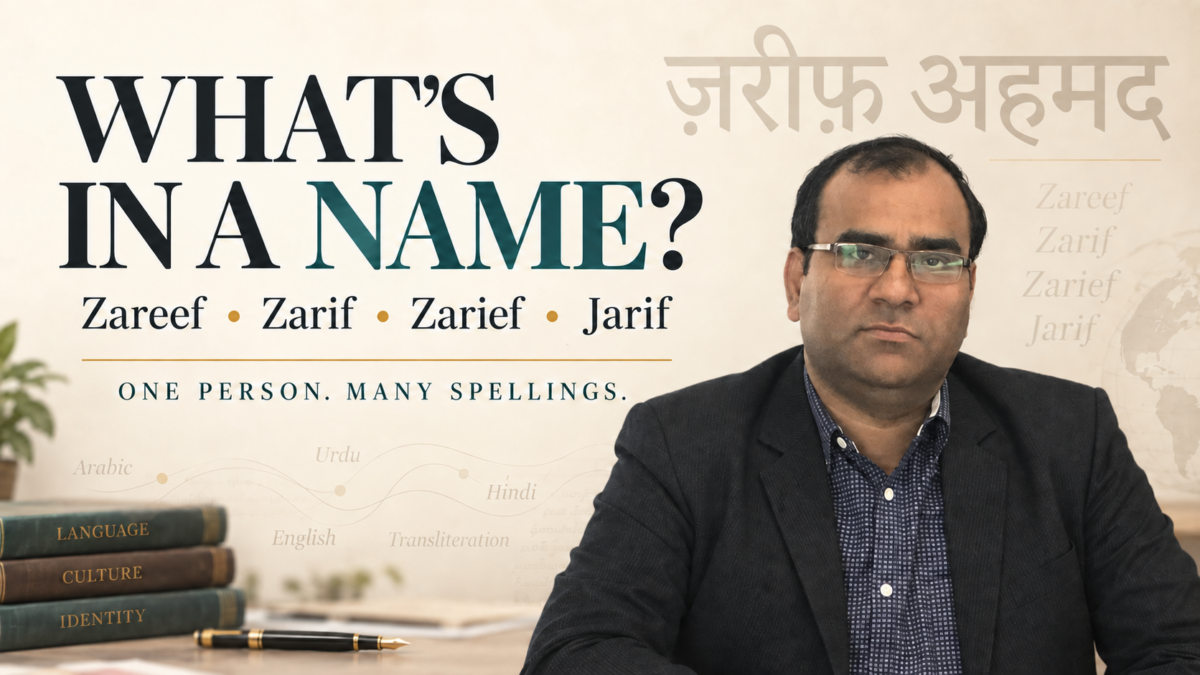
I am Zareef Ahmed, a software architect and consultant. You may also have met me as Zarif Ahmed, Zarief Ahmed, Zareif Ahmed, Jarif Ahmed or Zareef Ahmad. All of those are one person, and Zareef Ahmed is my official name, spelled exactly that way on every document I own. Like many people with Indian names, I live with the fact that the Roman spelling of my name is not consistent in the world around me, so whenever someone asks for my name, I have the habit of spelling it out, letter by letter, especially if they are about to write it down somewhere that matters.
In a hurry? Skip the story and jump to
Who is Zareef Ahmed Articles Consulting Books Podcasts Contact me
Where the spellings come from
The name is Arabic in origin and reached the languages of India through Persian and Urdu. Zarif means refined, elegant, witty. Ahmad means the most praised. Both words have a settled spelling in the Arabic script, and a settled spelling in Urdu. The trouble starts the moment they are written in any other script.
I should admit that none of this was on anyone’s mind when I was named. I am not sure anybody in my family knew what the word meant at the time of my birth. My name was simply made from a family member’s name, a variant of it rather than the name itself, the way names are often passed down, and the meaning was something I looked up myself, years later. The name came first; the dictionary came much later.
In Hindi the name is written ज़रीफ़ अहमद. Look closely and you will see two small dots under two of the letters, the nukta, which turns ज (ja) into ज़ (za) and फ (pha) into फ़ (fa). The nukta is easy to drop, on a form, on a signboard, in a hurry. Drop it and the first letter reads as J. That is where “Jarif” comes from: not a mistake in hearing, but a mistake in dots.
The Roman spellings have a different cause. The long vowel in the middle of the name can be written ee, i or ie, and English gives no rule for choosing. The last vowel of Ahmad or Ahmed is a regional convention rather than a fact: the Arabic-speaking world mostly writes Ahmad, South Asia mostly writes Ahmed. There is no everyday standard for transliterating Indian names into Roman letters, no authority a clerk can consult, so each person filling in a form decides for themselves, and each decides differently.
The variants, and how to say it
These are the spellings I have seen attached to me. All of them are the same person.
| Spelling | Where it tends to appear | Same person? |
|---|---|---|
| Zareef Ahmed | My official spelling: identity documents, education records, this website | Yes |
| Zarif Ahmed | The common transliteration in Persian and Arabic contexts, and in dictionaries | Yes |
| Zarief Ahmed | Forms filled by someone spelling from sound | Yes |
| Zareif Ahmed | Typing errors and autocorrect | Yes |
| Jarif Ahmed | Hindi speakers, when the nukta is lost | Yes |
| Zareef Ahmad | Anyone following the Arabic convention for the second name | Yes |
Say it as za-REEF AH-med, with the stress on the second syllable of the first name. If you have only ever seen it written, that is all you need.
What it has cost me
Most of the time a wrong spelling is a small thing, a name on a delivery slip that nobody checks again. Sometimes it is not. I have bought household items whose invoices carry a different spelling of my name, and when the time came to claim a warranty or book a service visit, the name on the invoice did not match the name on my identification. Proving that the two are the same person, for a water purifier, is a strange way to spend an afternoon.
At some authorities the Hindi spelling in their records was correct and the Roman spelling was not. The record was about me, in one script, and about someone else, in the other. Getting that checked and corrected was a long process, with the usual visits, forms and waiting.
I have been lucky in one respect, and the luck was manufactured. All of my official documents carry the same spelling, because I took care of it early and kept taking care of it. A consistent school and education record was the anchor: every later document could be matched back to it. Without that anchor, each correction would have needed a correction of its own.
What I do about it
- I spell it out, every time, before the other person starts writing. Z, A, R, E, E, F. It takes four seconds and saves four weeks.
- I keep one spelling on every document, from the earliest school certificate onward. No document gets to be the exception, however unimportant it seems on the day.
- I check the Roman spelling on any new document before I leave the counter. Corrections are cheap while the person who typed it is still in front of you and expensive after.
- I keep the paper trail of every correction I have had to make, so that the next mismatch can be answered with a document rather than an argument.
- Online, I use the same handle everywhere: zareefahmed. One spelling, one identity, wherever you find me.
If your name travels between scripts
This is not only my problem. It belongs to anyone whose name was born in one script and has to live in another: most of India, much of the Middle East, East Asia, Eastern Europe, and every family that has moved between them. What I have learned, offered as advice and not as law:
- Decide the Roman spelling once, and early. For a child, decide it at the birth certificate and never revisit it. The spelling itself matters less than the decision.
- Align the documents that other documents are checked against: the school leaving certificate and the tax and identity records. Once those agree, everything downstream can be corrected by pointing at them.
- On invoices, tickets and registrations, insist on the spelling that is on your identification, and say why. A shop will change a name on an invoice in a minute; a warranty department may not.
- When a mismatch appears, fix it at the source document rather than learning to live with two versions of yourself. Two versions become four.
- Keep a note of the variants that have appeared, as I have on this page. It turns a confusing history into a short explanation.
A note from the architect: how software should treat names
I have spent two decades building systems, and many of the mismatches above were produced by software that did exactly what it was told. A name field that demands an exact match will reject a transliterated name every time one letter moves. The phonetic algorithms most systems reach for, Soundex and Metaphone and their descendants, were designed for English surnames and were never taught that ज़ and ज are one sound apart, or that ee and i can be the same vowel.
Systems that get this right do a few simple things. They store the native-script name alongside the Roman one, so the more precise spelling is never thrown away. They match with a tolerance that understands transliteration, treating Zareef and Zarif as candidates for the same person rather than as strangers. They put a human in the loop before a mismatch becomes a rejection, because a person can see in a second what a rule cannot. And they never silently “correct” a name to what the software thinks it should be; the person in front of the counter is the authority on their own name. None of this is difficult. It is a matter of deciding that names are data about people, not strings to be compared.
So, what is in a name?
The answer to my own question is in two parts. Part of the solution is personal discipline: one spelling, chosen early, defended at every counter. Part of it is systems that treat variation as normal, because for most of the world it is. Neither part works alone.
The name itself means refined and praiseworthy, which is a lot to live up to under any spelling. I answer to all of them. I write only one.
And in fairness to the name, it has paid me back for all the trouble at least once. There is a story, which I will tell properly some other day, of how it played a part in my finding my life partner. I got married because of my name, or at least I believe so, and nobody at home has managed to prove otherwise. So whatever the clerks and the invoices do to it, I owe it more than I can complain about.
If you reached this page by searching for Zarif Ahmed, Zarief Ahmed, Zareif Ahmed, Jarif Ahmed or Zareef Ahmad, you found the right person: all of them are Zareef Ahmed. You can read more about me here.