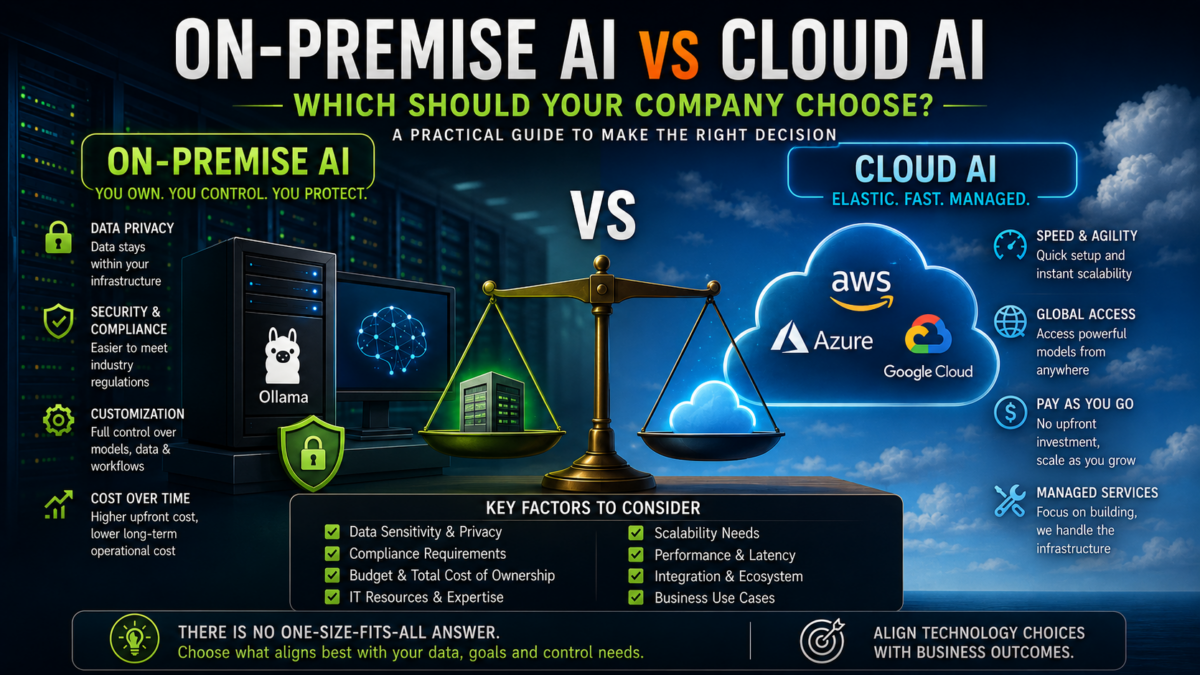
Every company adopting generative AI eventually faces the same question, usually sooner than it expected: should we call a cloud AI API, or run the models ourselves? I have sat on both sides of this decision, first for my own projects and then for clients, and the honest answer is that neither option is simply better. They are different bets, and which one is right depends on facts about your organization that no vendor benchmark will tell you.
This article is the decision framework I use in private AI deployment consulting engagements, written down so you can run it yourself.
The real question is where your data may travel
Strip away the marketing and the two options reduce to this. With cloud AI, your prompts, code, and documents travel to someone else’s servers, are processed there, and the responses travel back. With on-premise AI, open models run on hardware you control, inside your network, and nothing leaves. Every other difference (cost shape, latency, capability, operations) flows from that one distinction.
So before comparing model quality or prices, answer the prior question: is there data in your workflows that must not leave your control? Not “would prefer not to”, but “must not”: regulated patient data, client code under NDA, unreleased financials, government workloads. If the answer is yes, the decision is already mostly made for those workloads, and the rest of this article is about everything else.
The five factors that decide it
1. Data sensitivity and compliance
Cloud AI providers offer enterprise agreements, data-processing addenda, and no-training commitments, and for many businesses those are genuinely sufficient. But a contract is a promise, not a control. If your auditors, your clients, or your regulator require demonstrable technical control over where data lives, an agreement that data “will not be retained” does not satisfy them. On-premise deployment converts a legal assurance into an architectural fact.
2. Cost shape
Cloud AI is metered opex: you pay per token, forever, and the bill scales with adoption. That is wonderful when usage is small or experimental and painful when a hundred engineers use AI assistance all day. On-premise is mostly capex: GPU hardware up front (or reserved rental), then electricity and maintenance. The crossover point comes earlier than most people think for steady, high-volume internal workloads, and later than enthusiasts claim for spiky or occasional ones. Model the next eighteen months of realistic usage before deciding; the shape of your usage curve matters more than the absolute numbers.
3. Latency and availability
A cloud API adds network round trips and shares capacity with the world; you inherit its rate limits, its outages, and its throttling during peak demand. Local inference runs at the speed of your own hardware with no rate limits. For interactive uses like coding assistants, consistent sub-second responses change how tools feel and therefore whether people use them. If AI is going into a product or an internal tool with real-time expectations, measure both paths under load before committing.
4. Capability requirements
Here is the trade in plain terms: the largest frontier models are available only through cloud APIs, and for the hardest reasoning tasks they remain ahead. Open models you can self-host have closed most of the gap for everyday workloads: summarization, retrieval-augmented question answering, code completion, drafting, classification. The question is not “which model is best” but “what does this workload actually need”. Most internal workloads need far less than the frontier, and paying frontier prices (and frontier data exposure) for them is waste.
5. Team capability
On-premise AI is infrastructure. Someone must size the hardware, serve the models, monitor quality, and apply updates. If your team already runs production infrastructure, this is familiar work with new specifics, and tools like Ollama have made the serving layer dramatically simpler than it was two years ago. If you have no operations capability at all, the cloud’s managed convenience is worth real money, and pretending otherwise leads to stalled deployments.
When cloud AI wins
- Your usage is exploratory, low-volume, or spiky, so metered pricing works in your favor.
- Your workloads genuinely need frontier-model capability.
- Your data carries no regulatory or contractual restrictions, and provider agreements satisfy your risk assessment.
- You have no infrastructure team and no appetite to build one.
When on-premise AI wins
- Data must demonstrably stay inside your network: compliance, client contracts, or classification demand it.
- Usage is steady and high-volume, so per-token pricing has become a tax on adoption.
- Latency and availability need to be under your control because AI sits in an interactive tool or product path.
- Your workloads are well served by current open models, which is true more often than the frontier-model marketing suggests.
- You already run production infrastructure and can treat model serving as one more service.
The answer is usually both
In practice, most organizations I work with land on a hybrid: sensitive and high-volume workloads run on-premise, while exploratory work and frontier-dependent tasks use cloud APIs under an enterprise agreement. The mistake is not choosing one side or the other; the mistake is defaulting into cloud for everything because it was easiest to start with, and then discovering that sensitive data has been flowing through third-party APIs for a year without anyone deciding it should.
Decide deliberately, workload by workload. Write down which data classes may use which path. Revisit the decision twice a year, because open-model capability and hardware economics are both moving quickly, and the right answer this year may not be the right answer next year.
Next steps
If you want to try the on-premise path hands-on, start with my guide to running AI models locally with Ollama; my open-source tool ailane will tell you what your existing hardware can already run. For the bigger picture of what a production deployment involves, see my private AI deployment consulting page. And if you are weighing this decision for your organization and want an experienced second opinion, tell me about your situation.
