Automation using AI bots can create problems in personal and professional relationships. An automated email or message sent by an AI agent can, by accident, offend someone you have respected for years. I wrote a short version of this on LinkedIn and the replies convinced me it deserves a longer one, because the problem is specific to how we talk to each other in India, and the usual advice about email templates does not cover it.
We address people in many ways, and each one means something
Automating personal messages and emails in India is more complicated than it looks. We address people in so many different ways: Sir, Madam, Bhai, Bhaiya, Didi, or the person’s name followed by Ji. Sometimes the first name on its own, sometimes a nickname only two people use. The right choice does not come from a rule. It comes from the relationship and from how we have always spoken to that person. The form of address is part of the relationship itself, and both sides notice when it changes.
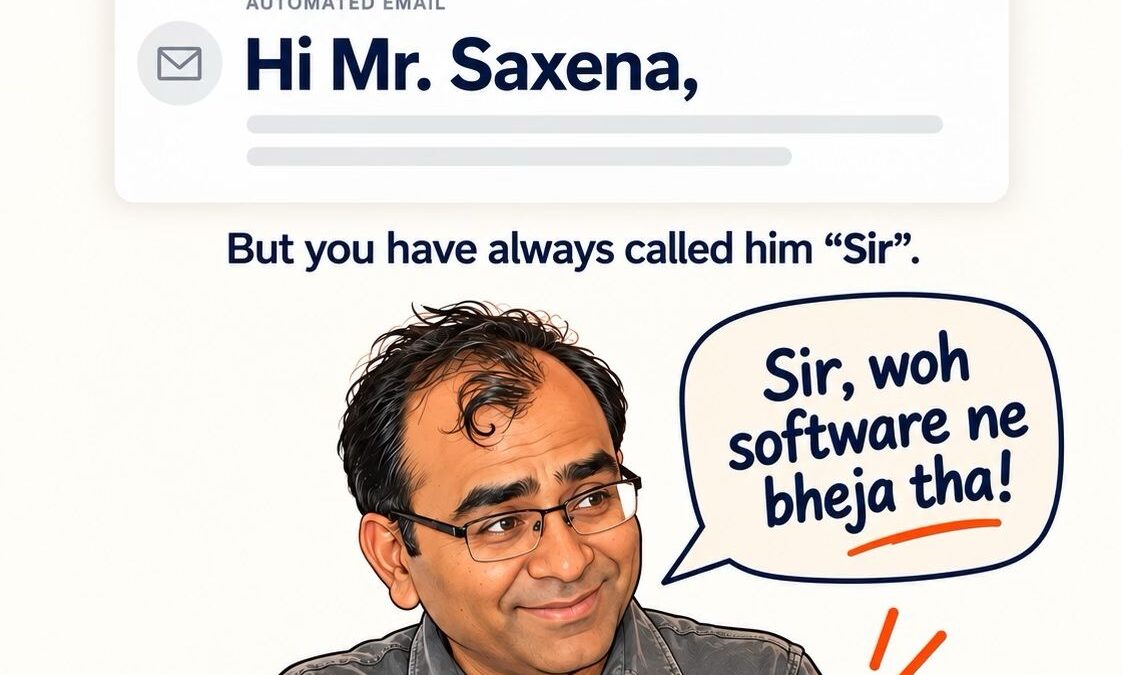
Imagine you have always called someone “Sir.” Then, one day, your automated email reaches them with “Hi Mr. Saxena.” The greeting is polite. In an English textbook it is correct. But inside your relationship that sudden change can feel distant, or even disrespectful, as if you have decided to put some formality between you. The opposite failure is just as real: a warm “Bhaiya” sent to a client who has only ever been “Sir” reads as presumptuous.
You know it was an automated message. They may not. As far as they are concerned, those words came from you, in your name, from your address. Even leaving the salutation out entirely can feel awkward in some relationships, because a person who has always been greeted notices the day they are not. A small detail in a template becomes a personal misunderstanding, and misunderstandings about respect are the ones people remember.
Why this is harder than a template problem
This is where automation gets difficult. You cannot manually check every message when the whole purpose was to stop checking messages. The salutation is the first line, so it is the first thing the reader judges, and it is also the one line a merge field handles worst, because the data it needs is not in any field. A customer record holds a name, a title and a company. It does not hold “we have called each other Bhai since 2011.”
Large language models make this worse in a quiet way. They are very good at producing a greeting that is correct for a stranger. Correct for a stranger is exactly the wrong register for someone you know. The better the model is at generic politeness, the more confidently it will write “Dear Mr. Saxena” to a man who has been “Saxena Sir” to you for fifteen years.
So you automated the emails to save time. Now you are personally calling people to explain: “Sir, woh software ne bheja tha.” (Sir, the software sent that.) The time you saved went into apologies, and the apologies cost more than the time.
What I do about it now
I asked for suggestions on LinkedIn, and together with what I had already learned the hard way, this is where I have landed.
- Treat the salutation as data, not as a template. Every contact I automate anything for has a stored “how I address this person” value, written by me, in the exact words: “Saxena Sir”, “Priya Ji”, “Rahul Bhai”, “Hi Anand”. The automation inserts that string and never composes a greeting of its own. If the value is empty, the message is not sent.
- Keep a do-not-automate list. Some relationships are worth a hand-written line every time: mentors, long-standing clients, anyone I would call rather than email. The list is short and it is the most valuable list in the system.
- Let the first message to anyone go through a person. Automation is for the hundredth message, not the first. The first one sets the register, and a person should set it.
- Default to the safer form when unsure. Between “Sir” and a first name, “Sir” offends nobody in India. Between a greeting and no greeting, a greeting. The automation should err toward respect, because the cost of too much respect is nothing and the cost of too little is a phone call.
- Never let the model change register. If a tool rewrites or “improves” a message, the salutation is locked. The model may fix the body; it may not touch the first line.
- Say when something is automated, where that is honest and acceptable. A transactional notice can carry a line saying it is sent automatically. A personal note cannot, which is exactly why it should not be automated.
The wider point
This is a small example of a large rule I keep meeting in AI work: the system must know when it does not know. A model does not know your relationship with Mr. Saxena, and nothing in your data will tell it. The right design is not a smarter guess. It is a system that asks you once, stores the answer, and refuses to send when the answer is missing. I apply the same idea in far bigger systems, where a low-confidence result goes to a person instead of into a record. A salutation is the smallest possible version of that decision, and it carries the most feeling.
If you have other ways of handling this, I would like to hear them. And to anyone who received a “Hi Mr.” from me when it should have been “Sir”: woh software ne bheja tha.
